Process
How Auto Transport Works
Six steps, no mystery. Here is exactly what happens between your first quote and the moment you sign for your vehicle.
1. Quote
You give us the pickup and delivery locations, the vehicle, whether it runs and your earliest available date. We price your actual lane against live carrier availability and send a firm number — not a placeholder that gets revised once you are committed.
2. Booking
Approve the quote and we open the order. The deposit is charged at the time of booking and covers our brokerage fee for sourcing, vetting and dispatching a licensed carrier, and we tell you exactly what that fee is before you pay. You get written confirmation with the pickup window, equipment type and insurance limits.
3. Dispatch
We assign a vetted carrier running a full-size semi car hauler, verify active DOT authority and current cargo insurance, then send you the driver's direct phone number and truck details.
4. Pickup and inspection
The driver calls ahead, meets you at your address or a nearby safe location, walks the vehicle with you, photographs existing condition and completes the bill of lading. Loading uses soft-tie wheel straps — never chains on the frame or suspension.
5. In transit
Track progress and reach the driver directly. Expect roughly 500 miles a day. If weather, traffic or a DOT hours-of-service reset shifts the schedule, we call you rather than leave you guessing.
6. Delivery and sign-off
The driver calls ahead again, unloads, and you inspect against the pickup photos before signing the bill of lading. Final payment is due on delivery. That's the whole process.
At pickup
Document the pickup with photos and video
Photograph everything the day of pickup
- Photos of the truck and trailer that is picking up your vehicle
- A clear photo of the truck / trailer license plate
- A photo of the driver's CDL
- Photos of your car before loading — front, back, both sides and the top
- A video showing your car actually being loaded onto the truck
Photos taken beforehand are not accepted by insurance companies — they must be taken at pickup, the day the carrier loads your vehicle.
All claims must be filed with the carrier, not with Enterprise Auto Transport. The assigned carrier holds the cargo insurance on your vehicle; as a licensed broker we arrange the transport and do not carry cargo coverage.
Preparation
How to prepare your vehicle
Ten minutes of prep prevents almost every delivery-day dispute.
- Wash the vehicle so existing damage is visible in photos
- Remove toll transponders and parking passes — we are not responsible for tolls or fees in transit
- Remove loose items from the interior and trunk
- Leave about a quarter tank of fuel — no more
- Disable or note any alarm system for the driver
- Check for fluid leaks and mention them at booking
- Fold in mirrors, retract antennas, remove spoilers if removable
- Photograph all four corners, roof and interior before pickup
- Provide a spare key to the driver
FAQ
Process questions
How far ahead should I book?
One to two weeks is comfortable most of the year. During snowbird season (October–December southbound, March–May northbound) book three to six weeks out.
Can I put belongings in the car?
Up to 100 lbs in the trunk is generally allowed. Personal items are not covered by cargo insurance and should not be visible.
What if nobody can be there?
Any authorized adult can release or receive the vehicle — a neighbor, family member, property manager or shop employee.
How do I pay?
The deposit is charged at the time of booking, with the balance due to the driver at delivery. We accept card, check and bank transfer.
Equipment explained
How will my vehicle be moved?
Open, enclosed, winch-equipped, specialized — what decides which one applies to your vehicle, and what we need to know to make that call.
Not sure whether you need an open carrier, an enclosed trailer or a winch-equipped truck? That's okay. Tell us what you're shipping and we'll determine the appropriate transportation method.
Cars, SUVs & pickups that run
A standard running vehicle usually moves on a multi-car open carrier, or enclosed when you want it protected from weather and road debris.
Transportation options that may apply
- Open multi-car carrier — the common, lower-cost option
- Enclosed trailer (soft-tie) when protection matters
- Smaller open trailer for short lanes or tight-access addresses
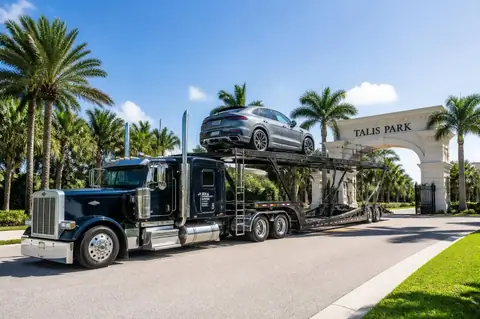
Most vehicles ride on an open 7- to 10-car carrier, secured by wheel straps rather than chains over the suspension. Enclosed transport puts the vehicle inside a hard-sided trailer with a lift gate and soft-tie straps, which is what we recommend for anything low, freshly painted or hard to replace. Which one you get depends on your preference, the lane and what is running it that week.
What we'll ask you about
- Year, make and model
- Any modifications: lift, lowering, wide body, roof rack
- Oversized tires or a camper shell
- Whether it runs, rolls, steers and brakes
- Both addresses and access
- Your date range
General guide: how vehicles usually move
A starting point, not a guarantee of equipment. Your shipment is reviewed before anything is assigned.
| What you're moving | Common transport method |
|---|---|
| Standard running car or SUV | Open carrier / enclosed by request |
| Low-clearance or exotic car | Enclosed with lift gate and soft ties |
| Classic or collector car | Enclosed / premium enclosed |
| Non-running but rolls and steers | Winch-equipped open or enclosed carrier |
| Seized, no wheels or no brakes | Specialized equipment / rollback |
| Lifted or dually pickup | Open carrier, position-dependent / specialized |
| Motorcycle | Enclosed with chock and soft ties / open |
| Electric vehicle | Open or enclosed / winch if disabled |
| Multiple vehicles together | Open carrier / dedicated enclosed load |
| Address a 75-foot truck cannot reach | Nearby meeting point, door-to-door otherwise |
Transportation equipment is determined based on the size, weight, condition, modifications, route and accessibility of your vehicle. The methods shown here are examples of equipment that may be used. Enterprise Auto Transport will review your shipment and work with an appropriate motor carrier to determine the best available transportation option.
Tires, brakes and anything that rolls: the owner's responsibility
- Anything that rolls or tows on its own wheels — boats, RVs, campers, utility and enclosed trailers, equipment trailers — must be roadworthy before pickup. That means sound tires with tread and no dry rot, correct air pressure, working bearings and hubs, functioning brakes and lights, a good coupler, safety chains and a spare if one is available.
- Equipment that has been parked for a long season is the most common problem. Tires that look fine can be dry-rotted and years past their date code, and bearings that have not been greased will run hot. If your boat or trailer has been sitting, have the tires and bearings checked before transport.
- The customer is responsible for the cost of any repairs needed to make the unit safe to move — tires, wheels, bearings, brakes, lights, couplers or anything else that allows the unit to roll or operate.
- If a tire blows out, a bearing fails or the unit becomes disabled in transit, the customer is responsible for the cost of towing to the nearest service facility and for the parts and labor to repair it. Roadside service on the highway costs considerably more than doing the work in advance.
- Repairs made on the road can add days to the delivery window. Enterprise Auto Transport is a licensed broker and is not responsible for the mechanical condition of the equipment, for the cost of repairs or towing, or for delays caused by them.
Start now
Get a quote in under two minutes
Not sure which type of carrier you need?
Don't worry. You don't have to know whether your vehicle belongs on an open carrier, an enclosed trailer, a winch-equipped truck or specialized equipment. Just tell us what you're shipping, its condition, where it's going and when you need it moved. We'll review the shipment and determine what type of transportation is appropriate.
Please note: Anything that rolls on its own wheels must be roadworthy before pickup. The customer is responsible for repairs — tires, bearings, brakes, lights — and for towing and repair costs if the unit becomes disabled in transit.
Ready to Ship your car?
Open and enclosed semi-truck carriers, door-to-door delivery and a coordinator who answers the phone.